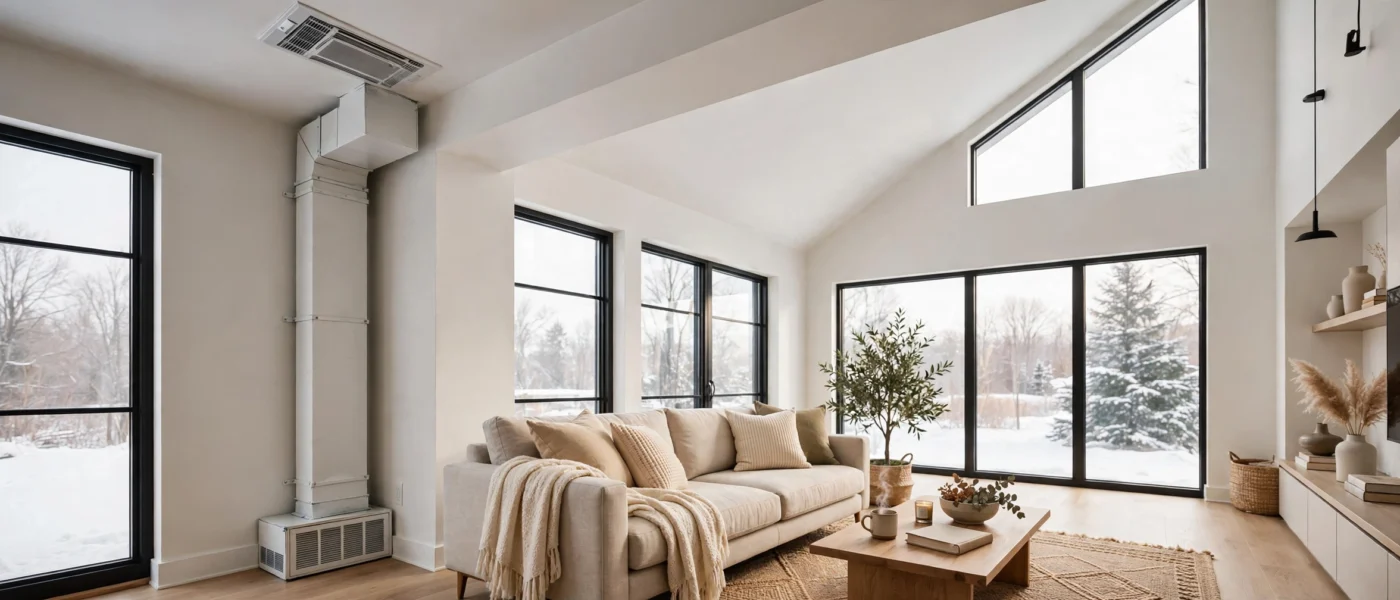
Warm Air at the Ceiling, Cold Air at the Floor?
Improve winter comfort with customized HVAC air distribution solutions. We evaluate existing ceiling supply vents and design removable or permanent duct modifications to help deliver heated air closer to the occupied area.
Why Is Your Room Cold at Floor Level Even When the Heat Is Running?
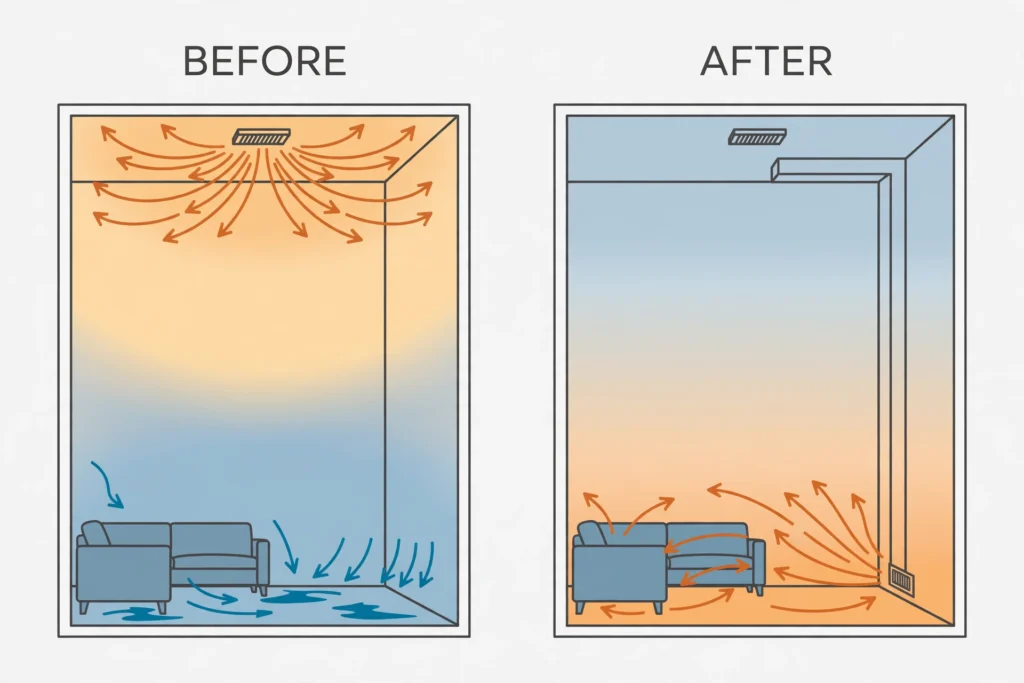
Heated air rises. When a room is supplied through ceiling vents, the warmest air can collect near the ceiling while the floor and the lower part of the room — where people actually sit, stand, and sleep — stay cold. This layering is called temperature stratification, and it is one of the most common reasons a room feels uncomfortable even though the thermostat shows the set temperature has been reached.
Common complaints we hear:
- The thermostat reaches its set temperature, but the room still feels cold.
- Warm air accumulates near the ceiling.
- Floors and lower occupied areas remain uncomfortable.
- Rooms with high ceilings are difficult to heat evenly.
- Upstairs areas are warmer than downstairs.
- Ceiling supply vents do not distribute warm air effectively.
Stratification is not the only possible cause. The same symptoms can come from inadequate airflow, poor insulation, air leakage, equipment problems, or improper system balancing. That is why we measure first: redirecting air will not fix a system that is not producing or moving enough heat, and we will tell you if a simpler repair or adjustment is the real answer.
Redirect Heated Air from Ceiling Vents Toward Floor Level
Step 1 — Existing Supply Air Opening. We evaluate the existing ceiling supply vent, available airflow, duct configuration, and heating performance.
Step 2 — Custom Duct Extension. When technically suitable, a custom-designed duct extension connects to the existing supply opening and routes heated air vertically along the wall.
Step 3 — Low-Level Air Discharge. A properly selected low-wall supply diffuser distributes heated air closer to the occupied area.
Step 4 — Airflow Testing and Adjustment. We verify airflow, pressure effects, and temperature distribution after installation.
Proper duct sizing and system compatibility are necessary — an extension that is too small or poorly connected can reduce airflow instead of improving comfort, which is why every installation starts with an assessment.
Air Distribution Solutions We Offer
Removable Seasonal Duct Extensions
Designed for applications where additional low-level heating distribution is useful during winter.
- Custom-fit duct extensions
- Exposed wall-mounted installation
- Removable or sectional construction
- Seasonal installation and removal where feasible
- Proper mechanical connections and supports
When the heating season ends, the extension can be removed and the original ceiling diffuser configuration restored, where the installation method allows it.
Permanent Low-Level Supply Conversion
For properties that benefit from a year-round or permanent air distribution modification.
- Custom duct routing
- Low-wall diffusers
- Air distribution redesign
- Integration with existing ductwork
- Airflow verification
A permanent low-level supply is designed around heating performance. It is not necessarily suitable for cooling without further evaluation — cool air behaves differently from warm air, and we assess both seasons before recommending a permanent conversion.
Alternative Heating Airflow Improvements
When vertical duct extensions are unnecessary or impractical, a simpler measure may resolve the issue:
- Air balancing
- Diffuser adjustment or replacement
- Airflow redirection
- Destratification fans
- Targeted duct modifications
We do not promote duct extensions when a simpler solution can resolve the issue.
Potential Benefits of Improved Winter Air Distribution
Improved floor-level comfort — warm air can be delivered closer to the occupied zone instead of collecting above it.
Reduced temperature stratification — properly designed distribution may reduce excessive temperature differences between floor and ceiling.
More consistent heating — better airflow patterns may improve comfort across the room, including areas the ceiling supply never reached well.
Potential heating efficiency improvements — in some buildings, reduced stratification can reduce heating demand, because the thermostat is no longer satisfied by a layer of warm air at ceiling level while the occupied zone stays cold. Actual energy savings depend on building conditions, equipment performance, controls, and system design; we do not guarantee utility bill reductions.
Custom solutions for existing buildings — certain installations can use exposed ductwork without extensive wall demolition.
Where Can Ceiling-to-Floor Heating Retrofits Be Useful?
- Apartments with ceiling-mounted supply vents
- Lofts and high-ceiling residences
- Offices and retail stores (light commercial spaces)
- Older buildings with uneven heating
- Spaces with noticeable ceiling-to-floor temperature differences
Suitability depends on duct access, airflow capacity, ceiling height, equipment configuration, building requirements, and available installation space. Some buildings restrict exposed ductwork or require management approval — we flag that during the assessment, before any work is quoted.
We Measure Before Recommending Duct Modifications
A retrofit starts with measurements, not with a sales pitch. Depending on the system and the complaint, the assessment can include:
- Ceiling and occupied-zone temperature measurements
- Supply airflow measurements (CFM)
- Supply and return air temperatures
- Static pressure evaluation, when applicable
- Existing diffuser inspection
- Duct routing and sizing assessment
- Airflow testing after modifications
Not every assessment requires every test; the measurements depend on the system and the complaint.
Our goal is to identify the simplest effective solution, not install additional ductwork unnecessarily.
If testing shows the real problem is balancing rather than vent location, our Air Balancing service may be the right fix on its own. If the heating system itself is underperforming, start with Heating Repair. Related services: Ductwork Installation and Heating Maintenance.
Frequently Asked Questions
Can ceiling HVAC vents be converted to floor-level heating outlets?
In many cases, yes — a duct extension or rerouted duct can carry supply air from a ceiling opening down to a low-level diffuser. Whether it works in your space depends on airflow capacity, duct access, and how the extension affects system pressure, which is why we assess and measure before recommending it.
Can heating ducts be installed externally along a wall?
Yes, exposed ductwork mounted along a wall is a standard approach for existing buildings where opening walls is impractical. The duct is custom-fit, mechanically connected, and supported along its run. Some buildings require management approval for visible ductwork — check before installation.
Can vertical duct extensions be removed after winter?
Seasonal extensions are designed to be removable or sectional where feasible. Removal restores the original ceiling diffuser configuration, where the installation method allows it. We explain exactly how a specific installation comes apart before you approve it.
Will redirecting warm air toward the floor improve comfort?
It can, when temperature stratification is the actual cause of the discomfort. If the cold room is caused by low airflow, heat loss, or an equipment problem, redirecting air alone will not solve it — the assessment is what separates one case from the other.
Can this modification reduce heating bills?
It can in some buildings: when the thermostat sits in or near the warm ceiling layer, the system may cycle in ways that leave the occupied zone cold, and occupants often compensate by raising the setpoint. Reducing stratification can reduce that waste. Actual savings depend on the building, the equipment, and the controls, and we do not guarantee a specific reduction.
Does this solution work with central HVAC systems?
It is designed for ducted central systems with ceiling supply vents — forced-air furnaces, heat pumps, and central air handlers. It does not apply to radiators, baseboard heating, or ductless mini-splits, which distribute heat differently; those systems have other options, starting with an assessment.
Is ceiling-to-floor duct conversion suitable for cooling?
Not automatically. Cool supply air is dense and tends to fall, so a low-level outlet that works well for heating can short-cycle cool air at floor level in summer. Removable seasonal extensions avoid the issue by coming off after winter. A permanent conversion needs a separate cooling evaluation.
Will additional ductwork reduce airflow?
Any added duct length and fitting adds resistance. A correctly sized extension, matched to the system’s capacity, keeps the effect small — and we measure airflow after installation to confirm. An undersized or poorly fitted extension can reduce airflow, which is exactly what the assessment and post-installation testing are designed to prevent.
Do I need building approval for exposed ductwork?
Possibly. Co-op, condo, and building management rules vary, and some modifications require permits or must be performed by appropriately licensed contractors. We do not present duct modifications as permit-exempt. During the assessment we identify what approvals your building is likely to require, and work that requires a licensed trade is handled by appropriately licensed and authorized contractors.
Can an existing air balancing service solve the problem instead?
Sometimes, yes. If the vents deliver uneven airflow but the supply locations are workable, balancing and diffuser adjustment may be enough. If the supply location itself is the problem — warm air entering at the ceiling of a high room — balancing alone usually cannot change where the air enters. The assessment tells us which case you have. See Air Balancing.
Service Area
Brooklyn · Manhattan · Queens · Staten Island · Nassau County, Long Island. Monday–Friday, 10:00 AM–6:00 PM. Call (917) 997-4525.
Tired of Cold Floors and Uneven Heating?
Find out whether your existing HVAC system can distribute heat more effectively. Fuse HVAC & Appliance Repair can evaluate airflow conditions and determine whether air balancing, diffuser adjustments, or custom duct modifications are appropriate.
How the visit is billed: an assessment visit follows our standard HVAC diagnostic policy — $99 + tax, credited in full toward approved work. If the right answer is a permanent conversion, the conversion itself is quoted as an installation estimate, which is free.
Request Service
Fill out the form below — our team will call or email you to confirm the details and schedule your visit.