Hot and cold rooms? Weak airflow from your AC vents? High heating or cooling bills?
Your HVAC system may be running, but conditioned air might not be reaching every room where it is needed.
If one bedroom stays hot while the living room feels freezing, or your upstairs never cools down properly, uneven airflow distribution could be contributing to the problem.
At Fuse HVAC & Appliance Repair, we provide residential and light commercial HVAC airflow evaluation and balancing services in Brooklyn, Manhattan, Queens, Staten Island, and Nassau County.
We focus on finding the cause of uneven airflow through measurements, evaluating the HVAC system, and identifying practical solutions to improve indoor comfort and equipment performance.
Call (917) 997-4525
Hot & Cold Rooms
One room is always hotter or colder than the others.
Weak Airflow
Some vents deliver strong airflow while others barely move air.
Uneven Floor Temperatures
Upstairs too hot, downstairs too cold.
High Energy Bills
Improper airflow can contribute to higher heating and cooling costs.
Are Some Rooms Too Hot While Others Are Too Cold?
A properly operating HVAC system should deliver an appropriate amount of conditioned air to each room based on its heating and cooling needs.
However, a system can produce enough cooling or heating overall while still distributing air unevenly.
One Room Is Always Hotter or Colder Than the Others
Your living room feels comfortable, but a bedroom stays several degrees warmer or colder.
This can be related to uneven airflow, ductwork restrictions, insulation differences, solar heat gain, or other factors.
Weak Airflow From AC Vents
Some supply vents deliver strong airflow while others barely move air.
Possible causes include duct restrictions, closed dampers, leaks, blower performance issues, or poor ductwork design.
Upstairs Is Too Hot, Downstairs Is Too Cold
Multi-story homes can experience significant temperature differences because of building heat gain, duct routing, airflow distribution, and HVAC zoning limitations.
Airflow testing can determine whether balancing adjustments could help.
Your HVAC System Runs for a Long Time
If your system struggles to maintain comfortable conditions, inadequate airflow or poor distribution may be one contributing factor.
Equipment capacity, thermostat location, insulation, and other mechanical problems must also be considered.
Some Rooms Feel Stuffy or Uncomfortable
Uneven air distribution may contribute to uncomfortable conditions, particularly in rooms with limited supply or return airflow.
Ventilation and indoor air quality problems require their own evaluation and may not be corrected through balancing alone.
Your Heating or Cooling Bills Are Higher Than Expected
Improper airflow can reduce HVAC efficiency or contribute to unnecessary operation.
Professional testing can help identify airflow-related problems that may be increasing energy consumption.
What Is HVAC Air Balancing?
HVAC air balancing is the process of measuring, evaluating, and adjusting airflow distribution in a ducted heating and cooling system.
The objective is to deliver the appropriate amount of air to individual rooms while maintaining proper total system airflow and equipment operating conditions.
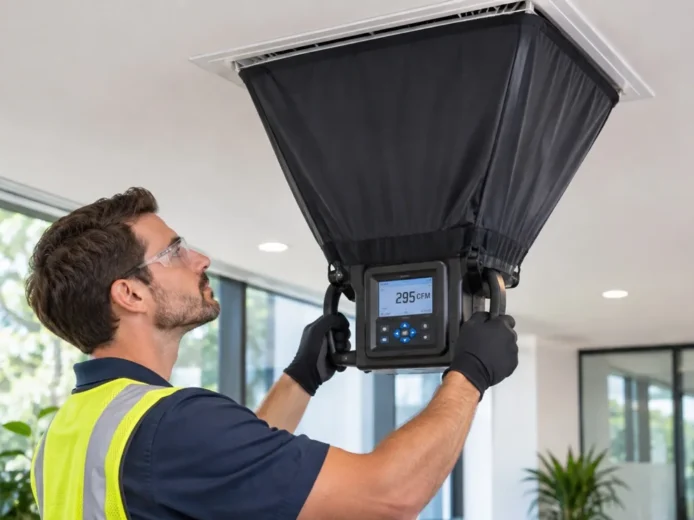
Airflow is commonly measured in CFM (cubic feet per minute).
A technician may measure airflow at supply registers, return grilles, and other accessible points to identify significant differences or restrictions.
Air balancing may involve:
- Measuring airflow at individual supply registers.
- Evaluating return airflow and return-air restrictions.
- Measuring total external static pressure where appropriate.
- Checking filters, accessible ductwork, and airflow restrictions.
- Inspecting existing balancing dampers.
- Evaluating blower operation and available fan settings.
- Comparing measurements against equipment requirements and available design information.
- Adjusting accessible dampers where appropriate.
- Rechecking airflow after adjustments.
Air balancing is not simply opening and closing air vents. Adjustments must account for total system airflow, static pressure, and HVAC equipment requirements.
What Causes Uneven Airflow in a Home or Building?
Not every hot or cold room requires the same solution.
Poor Ductwork Design
Undersized ducts, excessive duct lengths, restrictive fittings, or poorly configured branches can prevent conditioned air from reaching certain areas.
Closed or Incorrectly Adjusted Dampers
Balancing dampers control how airflow is distributed between duct branches. Incorrect settings can cause some rooms to receive too much air while others receive too little.
Leaking or Damaged Ductwork
Disconnected, damaged, or poorly sealed ducts can lose conditioned air before it reaches the intended room.
Restricted Return Airflow
Insufficient return-air pathways, obstructed grilles, or restrictive filters can contribute to airflow and pressure problems.
Incorrect Blower Settings or System Restrictions
Improper fan configuration and excessive static pressure can affect overall airflow delivery.
Renovations or HVAC Equipment Replacement
Changing room layouts, modifying ductwork, or replacing HVAC equipment can alter airflow requirements and distribution.
Building Heat Gain and Insulation Problems
Sometimes airflow is not the primary cause. Windows, insulation, solar exposure, air leakage, and equipment sizing can also produce uneven temperatures.
Our goal is to identify the contributing factors before proposing adjustments or repairs.
Why Is HVAC Air Balancing Important?
1. Improve Comfort Throughout Your Property
Proper airflow distribution can reduce temperature differences between rooms and help conditioned air reach areas that are not receiving enough heating or cooling.
This is particularly useful for homes with multiple bedrooms, multi-story layouts, or uneven room temperatures.
2. Support More Efficient Heating and Cooling
When conditioned air is distributed poorly, occupants may compensate by lowering the cooling setpoint or increasing the heating setpoint.
Correcting airflow problems may reduce unnecessary equipment operation under certain conditions.
3. Support Proper HVAC Equipment Operation
Correct total airflow is important for heating and cooling performance.
Airflow restrictions or incorrect fan settings can contribute to equipment operating problems, including excessive temperature rise in heating systems and evaporator icing risk in cooling systems.
4. Reduce Guesswork and Unnecessary Repairs
Airflow measurements help distinguish distribution problems from equipment malfunctions, ductwork limitations, and other building-related causes.
This may prevent unnecessary replacement of components that are functioning correctly.
5. Verify Performance After HVAC Installation or Renovation
Airflow testing is useful after equipment replacements, ductwork modifications, or changes to the building layout.
It helps determine whether the system is delivering airflow consistent with applicable equipment and design requirements.
Can HVAC Air Balancing Help Lower Your Energy Bills?
Yes, in some situations. But the savings depend on the underlying problem.
When an HVAC system distributes conditioned air unevenly, occupants may change thermostat settings to compensate for rooms that remain too hot or too cold.
This can increase heating or cooling demand and may cause equipment to operate longer than necessary.
Improving airflow distribution can help by:
- Delivering conditioned air more effectively to rooms that need it.
- Reducing unnecessary overheating or overcooling in certain areas.
- Identifying restrictive airflow conditions that may affect system efficiency.
- Helping the HVAC system operate within appropriate airflow and pressure conditions.
- Identifying ductwork problems that may require separate repairs.
Does Every Air Balancing Service Reduce Energy Consumption?
No.
Air balancing primarily improves airflow distribution. It does not automatically reduce energy usage.
If the HVAC system already operates efficiently, balancing may improve comfort without producing a substantial change in utility bills.
Actual savings depend on equipment condition, ductwork, insulation, thermostat settings, weather, and how the system is used.
Our approach is to measure the problem, determine whether airflow corrections are appropriate, and explain what results can reasonably be expected.
Our HVAC Airflow Testing & Balancing Process
Step 1. Review Your Comfort Problems
We identify the affected rooms, discuss temperature differences, and review when the problem occurs.
Examples include rooms that are uncomfortable only during cooling, rooms with weak vents, or spaces that struggle to reach the thermostat setpoint.
Step 2. Evaluate HVAC System Conditions
We inspect accessible system components and look for factors that may be affecting airflow, including filters, return-air restrictions, ductwork conditions, and blower operation.
Step 3. Measure Airflow and Static Pressure
Depending on the system and access conditions, testing may include airflow measurements using appropriate instruments and static-pressure measurements.
The collected data helps identify restrictions, airflow differences, and potential system-performance problems.
Step 4. Evaluate Airflow Distribution
We review the measured airflow and available equipment or design requirements to determine whether balancing adjustments are appropriate.
Where original room-by-room design values are unavailable, additional assessment may be necessary before establishing target airflow.
Step 5. Make Appropriate Adjustments
If the system has accessible balancing dampers or adjustable fan settings, suitable corrections may be performed within equipment and system limitations.
Adjustments that require additional repairs, new components, or ductwork modifications are quoted separately.
Step 6. Verify Results and Explain Next Steps
After adjustments, affected measurements can be repeated to determine whether airflow distribution improved.
We explain the findings, any remaining limitations, and whether additional corrective work is necessary.
Residential Air Balancing Services
We help evaluate uneven airflow in eligible ducted HVAC systems serving:
- Single-family homes.
- Townhouses and multi-story residences.
- Apartments and condominiums with accessible, individually controlled ducted systems.
- Residential central air conditioning systems.
- Ducted heat pump systems.
- Forced-air heating systems.
Whether your bedroom receives too little air or your upstairs remains warmer than the rest of the home, airflow measurements can help determine the next step.
For centrally managed building systems, testing or modifications may require building-management authorization.
Light Commercial Airflow Testing & Balancing
Uneven heating and cooling can also affect office spaces, retail stores, and other commercial properties.
Airflow problems may result in uncomfortable work areas, excessive drafts, temperature differences between rooms, or performance complaints after renovations.
Fuse provides HVAC airflow evaluation and balancing for eligible light commercial systems, with service scope determined by equipment type, site access, and project requirements.
Projects requiring independent certified TAB reports, specialized compliance testing, or formal engineering certification must be evaluated separately.
When Should You Schedule Air Balancing?
Consider professional airflow testing when:
- One or more rooms consistently remain too hot or too cold.
- Airflow from certain vents is noticeably weaker.
- Your upstairs and downstairs have significant temperature differences.
- HVAC equipment has recently been replaced.
- Ductwork has been modified or extended.
- A renovation has changed the building layout.
- Previous HVAC repairs have not solved comfort complaints.
- You want to verify airflow distribution before investing in major system changes.
Air Balancing vs. HVAC Maintenance vs. Duct Cleaning
These services solve different problems.
HVAC Air Balancing: Measures and adjusts airflow distribution through the system.
HVAC Maintenance: Focuses on equipment condition, cleaning, routine inspections, and servicing.
Duct Cleaning: Removes accumulated dust or debris from ductwork.
Ductwork Repair: Addresses damaged, disconnected, leaking, restricted, or improperly configured ducts.
Some properties require more than one service, but air balancing should not automatically be sold as the solution to every comfort problem.
Why Choose Fuse HVAC & Appliance Repair?
HVAC System Troubleshooting
We evaluate airflow problems as part of the complete HVAC system rather than assuming every comfort issue is caused by improperly adjusted dampers.
Measurement-Based Assessment
Airflow and pressure measurements, when applicable, help guide diagnosis and evaluate the results of adjustments.
Practical Repair Options
If testing identifies mechanical problems or ductwork limitations, we can explain the required corrective work and provide a separate estimate for services within our scope.
Residential and Light Commercial Service
We work with residential and eligible commercial HVAC systems throughout our New York service area.
Clear Scope and Pricing
We explain the proposed diagnostic or balancing scope and applicable charges before work begins. Additional repairs or modifications require separate approval.
Frequently Asked Questions About HVAC Air Balancing
Why is one room in my house hotter than the others?
Uneven room temperatures may result from insufficient supply airflow, inadequate return pathways, ductwork problems, insulation differences, solar heat gain, or HVAC equipment limitations. Airflow testing helps identify whether balancing is an appropriate solution.
Can air balancing fix weak airflow from my AC vents?
Sometimes. If weak airflow is caused by incorrectly adjusted dampers or uneven distribution, balancing may help. If the cause is a damaged duct, excessive restriction, or blower problem, additional repairs may be necessary.
Why is my upstairs hotter than my downstairs?
Upper floors may experience greater heat gain, while ductwork routing and airflow distribution can make the temperature difference worse. Air balancing may improve comfort, but insulation, duct modifications, or zoning changes may also be required.
Will air balancing lower my electricity bill?
It may help when improper airflow contributes to inefficient operation or unnecessary thermostat adjustments. However, energy savings are not guaranteed, and balancing alone may not significantly change energy use.
Can I balance my HVAC system by closing air vents?
Closing registers without evaluating total airflow and static pressure may create excessive restrictions and other system problems. Proper balancing uses measurements and appropriate adjustments rather than guessing.
How do you measure HVAC airflow?
Technicians may use airflow capture hoods, anemometers, differential-pressure instruments, and other equipment appropriate for the system. Airflow is commonly expressed in CFM.
Do I need air balancing after installing a new HVAC system?
Airflow verification is an important part of proper ducted HVAC installation. If a newly installed system produces uneven temperatures, airflow testing can help identify whether distribution, ductwork, or equipment configuration is responsible.
Is air balancing the same as duct cleaning?
No. Air balancing evaluates and adjusts airflow distribution. Duct cleaning removes accumulated contaminants from ductwork. They are separate services.
How much does HVAC air balancing cost in NYC?
The cost depends on the number of systems and registers, accessibility, testing requirements, and the adjustments needed. We can discuss the property and proposed scope before providing pricing.
Can air balancing solve every heating and cooling problem?
No. Comfort problems can also result from insulation, equipment sizing, duct leakage, zoning issues, refrigerant problems, and other mechanical or building conditions. Testing helps determine the appropriate solution.
Do you provide certified commercial TAB reports?
Projects requiring formal certified testing, adjusting, and balancing documentation are evaluated separately to determine the required qualifications, reporting scope, and whether a specialized contractor is needed.
Schedule HVAC Airflow Testing & Balancing in NYC
Stop guessing why some rooms are too hot, too cold, or receiving insufficient airflow.
Fuse HVAC & Appliance Repair provides HVAC airflow evaluation and balancing services for residential and eligible light commercial properties throughout:
- Brooklyn
- Manhattan
- Queens
- Staten Island
- Nassau County
Contact us to discuss your HVAC system, the affected rooms, and the appropriate next steps.
Fuse HVAC & Appliance Repair
Monday–Friday, 10:00 AM–6:00 PM
Working with a high-ceiling space where warm air stays at the top? Our Seasonal Heating Air Distribution Retrofit service brings heated air down to the occupied zone with custom duct extensions.
Request Service
Fill out the form below — our team will call or email you to confirm the details and schedule your visit.