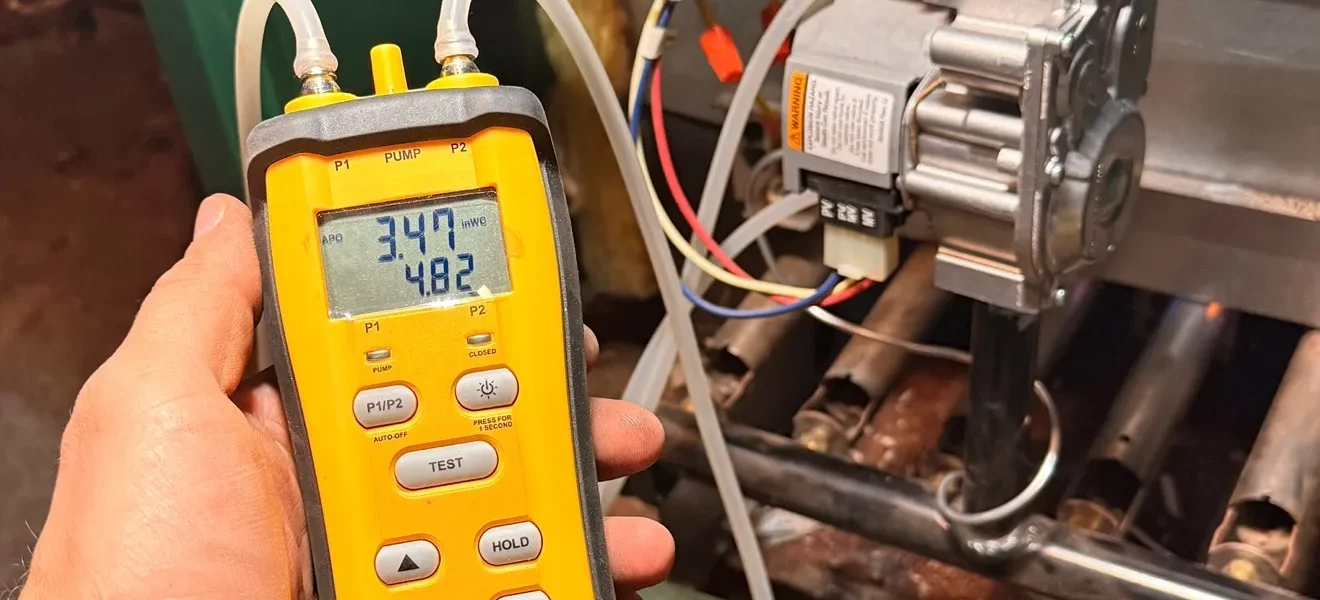
Professional gas valve pressure testing and manufacturer-specified adjustments for gas furnaces, boilers and compatible heating equipment.
Our service process includes checking inlet and manifold gas pressure, evaluating operating conditions, and determining whether adjustment or additional repair is necessary.
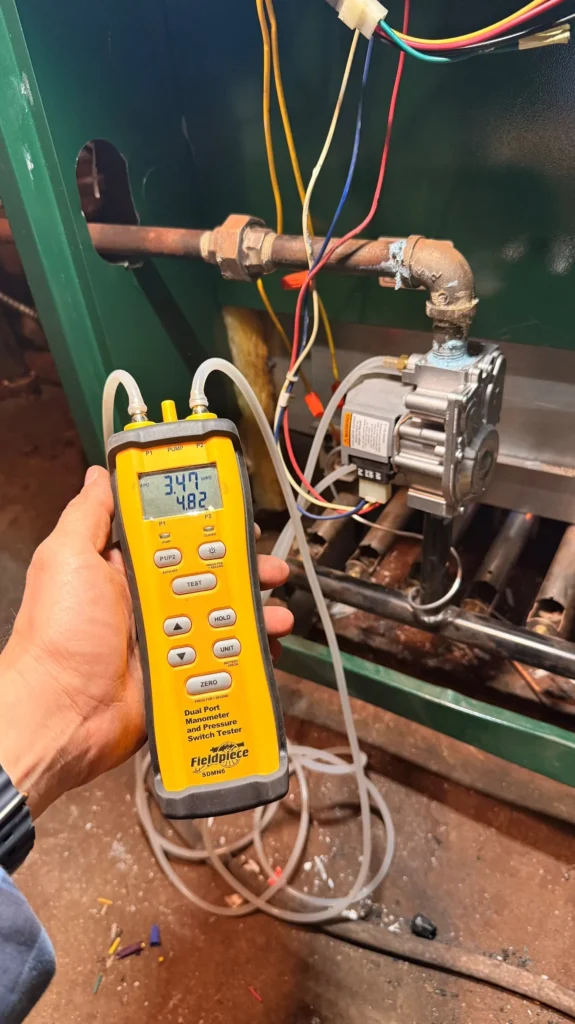
- Manufacturer-Specified Testing
- Upfront Repair Estimates
- Documented Pressure Measurements
- Regulated Gas Work Performed by Appropriately Licensed Specialists
When Should Gas Valve Pressure Be Checked?
Gas pressure testing may be appropriate when:
- The furnace or boiler fails to ignite consistently.
- The burner shuts off unexpectedly.
- The heating system experiences delayed or unstable ignition.
- A gas valve has recently been replaced.
- The manufacturer requires pressure verification during commissioning.
- A technician identifies abnormal combustion conditions.
- The system produces diagnostic codes associated with combustion or ignition.
These symptoms do not prove a gas pressure problem. The same symptoms can be caused by ignition components, safety controls, electrical supply problems, gas supply restrictions, a failed gas valve, or other equipment defects. Testing comes first: the measured pressures and the manufacturer’s specification determine whether an adjustment is appropriate at all — pressure adjustment will not resolve every problem on this list, and it is never a substitute for diagnosis.
Safety note: If you smell gas, suspect a gas leak, or a carbon monoxide (CO) alarm sounds, leave the affected area immediately and, from a safe location, contact your gas utility or call 911. Do not operate electrical switches or appliances, and do not book a repair visit as a substitute for an emergency response.
Related diagnostic services: Furnace Repair · Boiler Repair.
What Is Gas Valve Pressure Adjustment?
A gas valve controls the flow of gas to a burner. Two different pressures matter during testing:
Inlet Gas Pressure
The pressure supplied to the gas valve from the upstream gas supply system — the pressure arriving at the valve.
Manifold / Outlet Gas Pressure
The pressure delivered from the gas valve toward the burner assembly, where the equipment design provides for manifold pressure measurement.
The correct values are not universal. Required pressures depend on the equipment manufacturer, the fuel type, the operating mode, altitude, and the design of the specific valve. That is why there is no single “correct” number published on this page: the specification for your appliance, from the manufacturer’s documentation, is the only valid reference.
Many gas valves are factory preset and must not be adjusted unless the manufacturer’s service instructions expressly permit field adjustment.
This service is also different from gas piping pressure or tightness testing. Appliance manifold pressure testing evaluates how one appliance’s gas valve is set and operating. Piping pressure/tightness testing evaluates the building’s gas piping system itself. They are different procedures with different scopes, and one is not a substitute for the other.
Our Gas Pressure Testing & Adjustment Process
The following is a professional service overview. It is not a set of instructions for adjusting a gas valve yourself — gas valve adjustment is not do-it-yourself (DIY) work.
- Equipment Identification. Identify the appliance manufacturer, model, fuel type and the installed gas control configuration.
- Inlet Pressure Measurement. Measure the incoming pressure under the applicable operating conditions.
- Manifold Pressure Measurement. Measure the gas valve outlet or manifold pressure according to the manufacturer’s prescribed procedure.
- Specification Verification. Compare the measured values with the manufacturer’s documentation for that appliance and fuel type.
- Gas Valve Adjustment. Where necessary, permitted by the manufacturer, and legally authorized, adjust the appropriate gas valve pressure setting. Single-stage, two-stage and modulating equipment use different control designs, and not every valve uses the same adjustment procedure.
- Operational Verification. Verify ignition, burner operation and pressure stability under the applicable operating modes.
- Safety Verification. Perform applicable gas leak checks, combustion / carbon monoxide (CO) testing and safety-control verification, according to the equipment requirements and the approved scope of work.
- Service Documentation. Document the relevant readings and test results.
Additional repairs, specialized combustion analysis, or replacement components may require a separate estimate.
Heating Equipment We Service
- Gas Furnaces
- Gas Steam Boilers
- Gas Hot-Water Boilers
- Compatible Gas Burner Assemblies
- Selected Commercial Heating Equipment
Coverage depends on the specific equipment, site conditions and the availability of appropriately qualified personnel. Not every model or installation is compatible with field pressure adjustment, and we do not claim universal compatibility.
How Much Does Gas Valve Pressure Adjustment Cost?
Pricing is confirmed after equipment evaluation. You receive an upfront estimate before any adjustment or repair.
A gas valve pressure service starts with an HVAC diagnostic visit: $99 + applicable tax for an HVAC diagnostic visit. The diagnostic fee is credited toward an approved repair.
The final cost depends on the equipment type, access to the appliance, adjustment complexity, and any additional testing or repairs that prove necessary. Pricing for adjustment work is confirmed in the upfront estimate for your specific equipment — there is no universal flat price for every system, and the diagnostic fee is charged once and credited once, never twice.
See our Prices page for the standard diagnostic policy.
What Is Included — and What May Require Additional Work?
Four different services are often confused:
- Gas pressure measurement — testing inlet and manifold pressure against the manufacturer’s specification.
- Gas valve pressure adjustment — changing a valve setting, only where the manufacturer permits it and the work is legally authorized.
- Combustion analysis — a separate, more detailed evaluation of combustion performance; it is not automatically included in a basic pressure service.
- Gas valve replacement — replacing a failed or non-adjustable valve; a separate repair with its own estimate.
- Gas piping repairs and modifications — work on the building’s gas piping; a separate scope, subject to the licensing requirements described below.
A valve replacement, piping repair or extensive combustion troubleshooting is not included in a basic adjustment service.
If additional defects or component failures are discovered during the service, a separate supplemental estimate will be provided for customer approval before any additional work is performed.
Pressure adjustment is not performed if the valve is defective, is non-adjustable, or the manufacturer prohibits field adjustment. In those cases the documented readings and the available options are explained before any further work is proposed.
Gas Work in New York City — Licensing and Compliance
In New York City, regulated gas work is governed by the NYC Department of Buildings (DOB) under Local Law 150 of 2016. Gas work may be performed only by a Licensed Master Plumber, or by a person holding a DOB-issued Gas Work Qualification (or Limited Gas Work Qualification, under the required level of supervision) working under the direct and continuing supervision of a Licensed Master Plumber.
Fuse HVAC & Appliance Repair does not independently perform work requiring a plumbing license. Work requiring a licensed professional is performed by an appropriately licensed contractor.
An EPA 608 certification covers refrigerant handling. It does not authorize regulated natural-gas work, and we do not present it as doing so.
This page accepts general service inquiries. Scheduling of regulated gas-valve adjustment work is confirmed after the equipment evaluation and confirmation that an appropriately qualified, licensed provider is assigned to the work. We do not promise regulated gas work that we are not authorized to perform.
Service Area
We provide heating services across Brooklyn, Manhattan, Queens, Staten Island and Nassau County, Long Island. Hours: Monday–Friday, 10:00 AM–6:00 PM; Saturday–Sunday closed.
Frequently Asked Questions
What is gas valve pressure adjustment?
It is the process of measuring the gas pressure at an appliance’s gas valve — both the incoming (inlet) pressure and the pressure the valve delivers to the burner (manifold pressure) — comparing the readings with the manufacturer’s specification, and, where the manufacturer permits it and the work is legally authorized, adjusting the valve setting so the appliance operates within that specification.
What is the difference between inlet and manifold gas pressure?
Inlet pressure is the pressure supplied to the gas valve from the building’s gas supply. Manifold (outlet) pressure is the pressure the valve delivers toward the burner assembly. Both are measured during testing, because a problem on either side of the valve leads to a different conclusion.
How do I know if my furnace gas pressure is incorrect?
You cannot determine this from symptoms alone. Inconsistent ignition, unexpected shutdowns or combustion-related diagnostic codes can point toward a pressure problem, but they can also be caused by ignition parts, safety controls, electrical issues or a failed valve. Only a pressure measurement compared with the manufacturer’s specification confirms it.
Can incorrect gas pressure prevent a furnace from igniting?
Yes, pressure outside the manufacturer’s specified range can contribute to ignition failure or unstable burner operation. It is one of several possible causes, which is why testing precedes any adjustment.
Do all gas valves have adjustable pressure settings?
No. Many valves are factory preset, and some are not adjustable in the field at all. Adjustment is performed only where the manufacturer’s service instructions permit it. A non-adjustable or defective valve may need replacement instead, which is quoted separately.
How much does gas valve pressure adjustment cost in NYC?
The visit starts with the standard HVAC diagnostic: $99 + applicable tax, credited toward an approved repair. The price of any adjustment is confirmed after the equipment evaluation, in an upfront estimate, before work begins. It depends on the equipment type, access and complexity.
Can gas valve pressure be adjusted without replacing the valve?
Often, yes — if the valve is adjustable, functioning correctly, and the manufacturer permits field adjustment. If the valve itself has failed, adjustment cannot correct it, and replacement is proposed with a separate estimate.
Is combustion analysis included in the service?
Basic safety verification, including applicable carbon monoxide (CO) checks, is part of the service scope described above. A full, specialized combustion analysis is a separate service and, when recommended, is quoted separately before it is performed.
Do you service both furnaces and boilers?
Yes. The service covers gas furnaces, gas steam boilers and gas hot-water boilers, as well as compatible gas burner assemblies and selected commercial heating equipment, subject to equipment and site conditions.
Is gas valve adjustment the same as a gas line pressure test?
No. Gas valve and manifold pressure testing evaluates one appliance’s gas valve settings and operation. A gas line (piping) pressure or tightness test evaluates the building’s gas piping system. They are different procedures with different scopes and requirements.
Request an Evaluation
If your furnace or boiler shows ignition or combustion symptoms, or a manufacturer procedure calls for pressure verification, request an evaluation. We will confirm the diagnostic visit, document the measured pressures, and provide an upfront estimate before any adjustment or repair.
Request Service
Fill out the form below — our team will call or email you to confirm the details and schedule your visit.